The East Palace Rating & Review: Is It Worth Watching?
The East Palace rating currently sits at 7.9 on MyDramaList and around 7.6 on IMDb, with a 100% critics’ score on Rotten Tomatoes that comes with a giant asterisk I’ll get to in a second. My own score: 8/10. And yes, it’s worth watching — but probably not for the reason every headline is shouting at you.
Eight episodes. Roughly six hours. All of it dropped on Netflix at once on July 17, 2026.
This review is spoiler-free past episode one. I’ll tell you what you’re signing up for, not what happens.
The East Palace rating across every scoreboard (and what the numbers hide)
Here’s the full picture as of late July 2026:
- MyDramaList: 7.9/10, from roughly 244 scores and about 11,900 watchers
- IMDb: reportedly around 7.6/10, off roughly 1,100 votes
- Rotten Tomatoes: 100% from critics, 90–91% audience score
- Netflix maturity rating: TV-MA in the US (MyDramaList has it tagged 15+, which is a real discrepancy — trust the TV-MA, there’s a lot of blood)
Now the asterisk. That perfect 100% was sitting on about nine critic reviews when the “PERFECT SCORE” articles started flying. Nine. A single lukewarm review flips that number, and a couple of the counted reviews were 2.5/4 and 3.5/5 — positive, sure, but nobody’s carving them into stone. Rotten Tomatoes counts fresh vs. rotten, not how fresh.
So when you see “100% on Rotten Tomatoes” next to “7.9 on MDL,” those aren’t in conflict. One is a yes/no tally on a tiny sample. The other is thousands of drama sickos scoring out of ten. The 7.9 is the more honest number.
What you’re actually getting
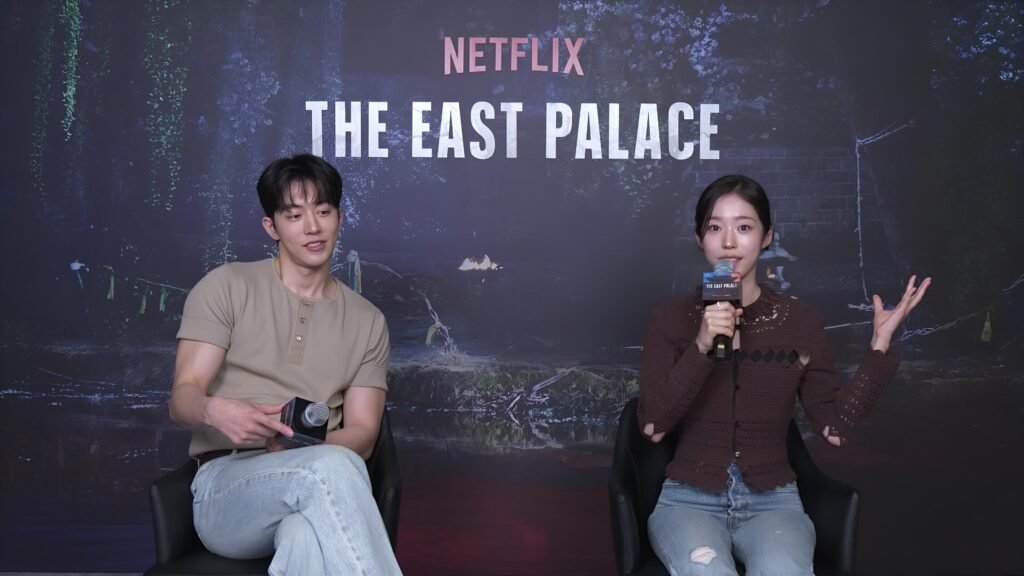
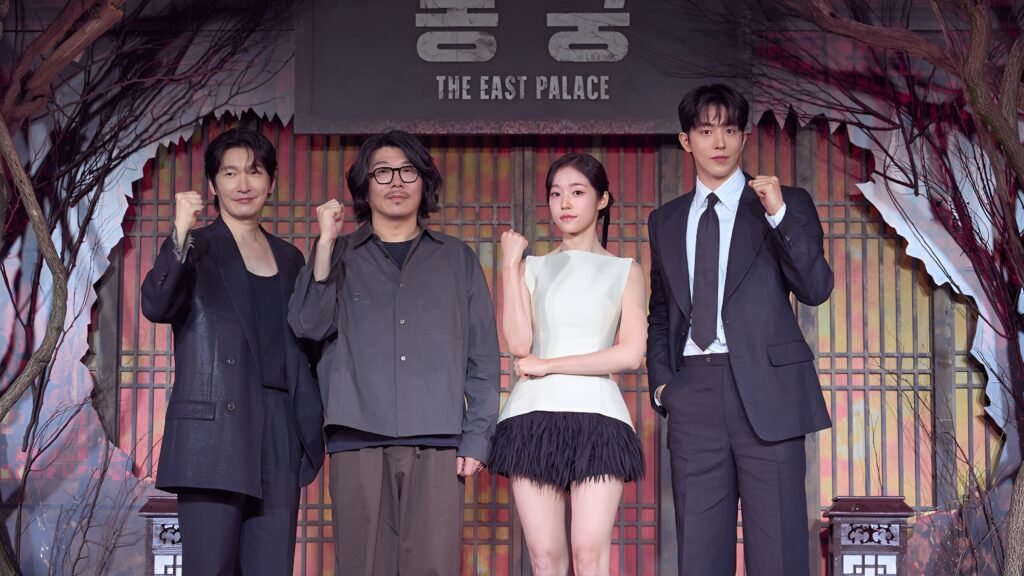
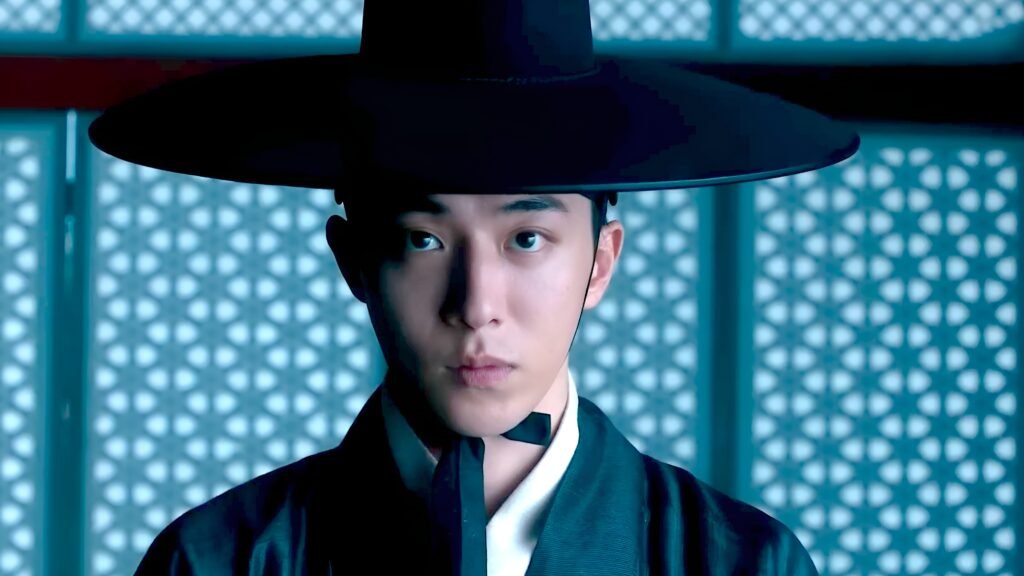
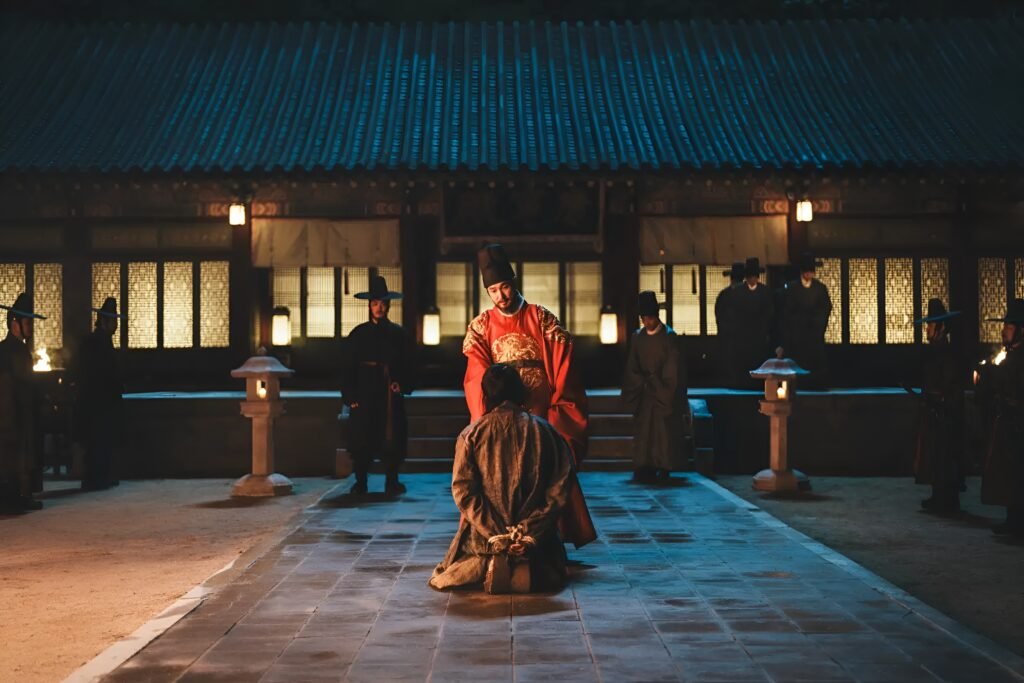
A string of crown princes has died inside the East Palace. Court gossip says the pond ghost is back — a spirit that cursed the royal bloodline three decades ago and has been collecting ever since. The king (Cho Seung-woo), who publicly has zero patience for superstition, quietly summons a ghost-slayer named Gu-cheon (Nam Joo-hyuk), who can physically cross into the Realm of Gwi and cut spirits down with a sword. He’s paired with Saeng-gang (Roh Yoon-seo), a court lady who hears the dead and considers it a lifelong curse.
That’s the whole setup. The title does double duty, by the way: donggung is the crown prince’s residence, and it’s also where three generations of royal sin have been quietly piling up.
Writers Kwon So-ra and Seo Jae-won did The Guest and Bulgasal: Immortal Souls. Director Choi Jung-kyu did The Devil Judge. If you know those three shows, you already know the DNA here — folklore taken seriously, worldbuilding that refuses to over-explain itself, and a moral center that’s about six shades muddier than usual.
The Realm of Gwi is the reason to press play
This is where the reported ~40 billion won budget went, and you can see every single one of them.
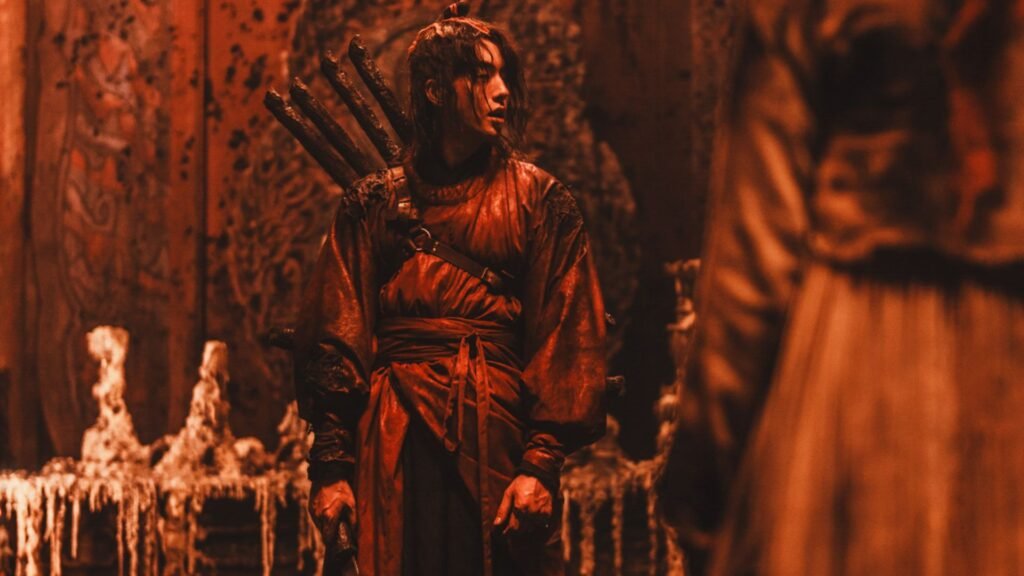
The spirit world isn’t a separate set. It’s the same space — same palace, same corridors, same courtyard — re-lit and re-graded until it reads as somewhere you’d die in. Reds bleeding into the frame. Air that looks thick. Gu-cheon steps sideways and suddenly the building he was standing in wants him dead.
That’s a directing choice, not a VFX flex, and it’s why the fantasy never feels like homework. You don’t need a lore dump to understand “same place, wrong side.”
Production had a genuinely brutal road to it, too. A fire tore through the filming facility in Yeoncheon in December 2024 and destroyed a 3,655-square-meter production building — a primary set and a pile of specialized lighting gear went with it. Nobody was hurt. The shoot reportedly ran more than eight months total. Post was finished well before release; Netflix’s global rollout schedule is what pushed it to July.
Also worth saying out loud: this is Netflix’s first Korean original sageuk since Kingdom, roughly seven years later. That’s a long time to leave that lane empty.
Kkeomeoksari deserves its own paycheck
The breakout star of this show is a small black clay-looking creature with enormous eyes that latches onto Gu-cheon and refuses to leave.
Korean media christened it the “Joseon Groot” almost immediately, and the fandom ran with it. My timeline was 30% palace horror and 70% Kkeomeoksari fancams within about 48 hours. The merch demand is real and loud enough that the director publicly said it isn’t his call but he hopes the enthusiasm gets somewhere.
The best part is that it isn’t invented IP bait. Kkeomeoksari comes from an obscure piece of oral folklore — a small dark figure that chases people while repeating “I am Kkeomeoksari” — and the name reportedly stitches together kkeomeok (pitch-black) and sal (living thing). The design gave it clay-doll texture on purpose. Adorable at a glance, deeply wrong if you look for more than four seconds.
And it isn’t a mascot. It survives by feeding on human life energy, and it’s feeding on Gu-cheon’s. That thing waddling around like a toy is slowly killing your protagonist. That’s the kind of detail casual coverage skips, and it’s the whole reason the character works.
The acting split nobody outside Korea is explaining properly
Here’s the discourse that actually matters, and where most English-language reviews go quiet.
Cho Seung-woo and Jang Young-nam are being praised without qualification. Their scenes together — especially the tea-service standoff between the king and the queen dowager — are the ones Korean viewers keep clipping. Kwak Dong-yeon’s crown prince has very little screen time and lands like a truck anyway; he barely speaks and it doesn’t matter.
Then there’s the split. A chunk of Korean viewers found the younger leads shaky, and the specific complaints were Roh Yoon-seo’s emotional delivery and Nam Joo-hyuk’s sageuk baljseong — his period-drama vocal delivery.
That last one is the piece international audiences structurally cannot judge. Sageuk diction is its own trained skill in Korea: a pitched, formal, slightly archaic cadence that court dialogue demands. Korean viewers hear it the way you’d hear a bad accent in an English-language film. If you’re reading subtitles, that whole layer is invisible to you.
So the 91% audience score on Rotten Tomatoes and the loud hobulho — the “some love it, some don’t” split — in Korea aren’t contradicting each other. They’re measuring different things. That’s not a gotcha; it’s just useful to know before you decide whose review to trust.
Where it genuinely wobbles
I’m not going to pretend this is flawless.
The first stretch is slow. It spends a lot of runtime laying track — relationships, rules, who’s related to whom — before it lets the horror off the leash. Multiple Korean outlets flagged exactly this, and if you came for genre momentum you’ll be tapping your foot through episode two.
The middle repeats itself. Ghost of the week, sad backstory, exorcism, next. Then the end of episode four detonates and the back half is a completely different, much better show. Several viewers I saw quietly dropped it before reaching that point, which is a shame, because that’s the pivot the whole thing was built for.
The Stranger Things problem. Everybody made this comparison. The red-drenched parallel dimension, the tentacle-shot void, a villain framed in his lair like a certain Netflix flagship baddie — Korean viewers were posting side-by-sides within hours of finishing episode eight. I don’t think it’s theft; the folklore underneath is specifically, unmistakably Korean. But when you borrow the single most recognizable visual signature Netflix owns, on Netflix, people are going to say the thing.
And one complaint I want to push back on. Plenty of viewers asked why a sword works on ghosts at all. Nam Joo-hyuk actually addressed this: he deliberately stripped the flourish out of the choreography and made Gu-cheon’s style defensive rather than aggressive, playing it as if he’s persuading spirits to release their resentment and move on instead of destroying them. Once you know that’s the intent, the “weak” swordplay reads as characterization. He also lost about six or seven kilos across the shoot on purpose, so the swings get visibly weaker as Gu-cheon’s yang energy drains out of him. In one of the episode three fights he was shooting with a cold and said he liked how feeble it looked. That’s not sloppiness. That’s a choice most reviews clocked as a flaw.
The Nam Joo-hyuk comeback context
You can’t talk about this show’s reception without this part.
The East Palace is Nam Joo-hyuk’s first project after a roughly three-year screen absence that included his military service. He’s also returning under a cloud: allegations that he bullied classmates in school. He has called them entirely groundless and pursued legal action, and the original informant was issued a summary order with a 7 million won fine for defamation over false claims. Public opinion still hasn’t fully settled, and it has colored some of the response to both his return and the drama. He’s said he didn’t want his personal situation to hurt the show.
That’s the confirmed shape of it. Where you land on it is yours.
So is The East Palace worth watching?
Watch it if: you liked The Guest, Bulgasal, Revenant, or Kingdom. You want folklore-driven horror where the mythology has actual internal rules. You’ll happily sit through a slow build for a strong back half. You want to watch two veterans cook in every scene they share.
Skip it if: you need a tight script above all else. You’re allergic to gore — the TV-MA is earned. You bounce off romance-adjacent subplots in genre shows, because there’s tension here that some viewers felt undercut the horror. Or you specifically wanted a traditional political sageuk, in which case this will feel like it wandered in from another building.
Start here if you’re unsure: watch episodes one and four back to back and stop. If four doesn’t get you, nothing after it will.
The commercial verdict is already in, for what it’s worth. Netflix logged 4.9 million views and 32.9 million viewing hours in the first three days, good enough for No. 2 on the global non-English chart — and it held that No. 2 spot for a second straight week. FlixPatrol had it at No. 1 in 17 countries and inside the Top 10 in 83. It was No. 1 in Korea and topped Good Data’s domestic buzz index for the third week of July.
Season 2: don’t get your hopes up yet
Netflix lists this as a limited series. No renewal has been announced. The ending is open — deliberately so — and the director has said the finale reflects hope rather than confirming a sequel setup.
Which means it comes down to what it always comes down to: whether the numbers hold long enough for Netflix to care. Kkeomeoksari merch would probably help.
My final call: 8/10. Uneven, occasionally derivative, and still the most visually confident Korean genre swing of 2026 so far. Watch it for the Realm of Gwi, stay for Cho Seung-woo, and accept that the first two hours are rent.
All eight episodes are streaming on Netflix. Viewership figures via Netflix’s official Tudum Top 10.
Now tell me honestly — did you make it past episode two on your first sitting, or did you bail and come back? Because I think that single decision explains almost every argument happening about this show right now. Drop it in the comments.